Influencer marketing is a $40.51 billion market in 2026, headed for $152.56 billion by 2031 according to Mordor Intelligence. Money like that attracts influencer agencies the way a porch light attracts moths, and nearly every one of them now has the same two words at the top of their homepage: full service.
Most influencer marketing companies using that label are describing a service they do not sell. Some are talent rosters that will happily introduce you to their creators and then vanish when the invoicing starts. Some are strategy shops that hand you a deck and a list of handles. Some run the organic side competently and go silent the moment you ask who manages the paid amplification.
This post does two things. First, it defines what a full-service influencer marketing agency actually is, with four pass/fail tests you can apply to any pitch. Second, it ranks the ten best influencer agencies that clear the bar in 2026. If you want the broader field, we also maintain our ranking of the top influencer marketing agencies overall.
What a Full-Service Influencer Marketing Agency Actually Is
A full-service influencer marketing agency owns the program end to end. The brand approves strategy, creative direction, and budget. The agency does everything else: creator selection and vetting, recruiting and outreach, rate negotiation, contracting, payment, briefing, content QA, making sure every post goes live to spec, paid amplification of the content, and detailed tracking of what it all produced. That is the entire definition, the full stack of influencer marketing services under one roof. Anything less is a partial service wearing the label.
The distinction matters because the label hides the labor. Running 100 creators means 100 contracts, 100 briefs, 100 content approvals, 100 posting deadlines, and 100 chances for something to go sideways. If you have already tried what influencer marketing is supposed to look like and ended up chasing creators about late posts yourself, you did not buy full service. You bought a spreadsheet with a retainer attached.
The workload is also where the quality lives. Content QA against a real creative brief, disclosure compliance, reshoot requests, posting windows: these unglamorous steps are the difference between a program and a pile of posts.
The Four Tests That Disqualify Most "Full-Service" Agencies
Apply these four rules to any agency pitch. They are pass/fail, and they eliminate most of the field.
1. If they cannot run paid amplification of the content, they are not full service. Organic reach is the bonus. The asset is the creator content itself, and the returns concentrate when that content runs as paid media: whitelisted creator ads beat brand-page ads by 20 to 35 percent on CPA in a 90-account 2026 benchmark (AdRiseLab, 2026), and TikTok's own testing found Spark Ads deliver 30 percent higher completion rates and 142 percent higher engagement than standard in-feed ads (TikTok data via Reloop). An agency that stops at the organic post is leaving the majority of the value on the table and calling it a win.
2. If they just connect you with talent from their roster, they are not full service. A roster is an inventory, and an agency selling its own inventory will always find that the right creator for your brand happens to be one they represent. Real creator selection starts from your customer and searches the whole market.
3. If they do not provide detailed tracking, they are not full service. Post-level metrics, spend, CPM, clicks, conversions where trackable, and an honest read on what the data can and cannot prove. Reporting is not a courtesy. It is a core deliverable you are paying for.
4. If you have to talk to the influencers directly, they are not full service. Creator coordination is precisely the labor you are outsourcing. When a creator misses a deadline, posts off-brief, or forgets a disclosure, that phone call belongs to the agency. Your team should live at the strategy and approval layer, nowhere below it.
Full-Service Agency vs. Talent Agency vs. Influencer Platform
Three different businesses get shopped as if they were interchangeable, and the confusion is profitable for two of them.
A talent agency represents creators, the way CAA represents actors. They are paid to maximize their clients' rates, which puts them on the opposite side of the negotiating table from you (CloutBoost). Useful if you want a specific creator. Not a program partner.
An influencer platform is software: a searchable creator database, campaign dashboards, filters, and automated workflows (Trend). Platforms are a fine choice if you have in-house ops headcount to do the selecting, negotiating, briefing, QA, and reporting. All of the work still belongs to your team.
A full-service agency works for the brand and owns the outcome. Plenty of influencer management agencies split the difference, running creator coordination but leaving paid media to your team. The four tests catch those too.
Here's where you get the stuff we don't put on the blog. Learn how to craft an entire TikTok marketing strategy from scratch, plus get access to our proprietary data on the top 100 creators and brands on TikTok by industry— and a lot more.
How We Ranked These Agencies
Five criteria, weighted in this order. End-to-end operational ownership: does the agency actually run creator selection through payment, or does it subcontract the middle? In-house paid amplification: can they whitelist, run dark posts, and manage ad spend themselves? Tracking and attribution depth: do they report like a partner or like a press release, and can you measure influencer campaigns properly from what they give you? Creator vetting and management at scale. And verifiable results: published numbers with named brands, not adjectives.
Agencies that fail one of the four bright-line tests did not make the list, however impressive the client logos. The ranking below draws on published case studies, client rosters, and how each agency describes its own influencer marketing services and operating model. Nobody audited anyone's books, and we say so plainly. For calibration: we have activated 40,000+ creators across six years of building programs, and this list reflects the patterns we see when brands come to us after a partial-service agency did not work out.
One more calibration note: the right evaluation window for any of these agencies is a three-month proof of concept, not a three-week sprint. Influencer is a channel you build. Optimization compounds over two to three cycles, and any agency that promises the math works in week two is selling you the sprint.
Why Brands Choose Influencer Agencies
Most marketing leaders who call us have already tried running influencer in-house, and the story is consistent. The channel worked well enough to prove demand, and then the operations ate the team alive.
The in-house math is unforgiving. One coordinator can realistically manage 15 to 20 creator relationships, counting discovery, outreach, negotiation, contracts, payment processing, and content QA. Scaling to 100 creators means building an ops department before the channel has earned one, which is exactly backwards.
The best influencer marketing agencies also carry knowledge a brand team cannot buy piecemeal. An agency negotiating its four-thousandth deal of the year knows what a mid-tier lifestyle creator actually costs, which creators deliver against brief and which inflate, and what a fair usage-rights clause looks like. Your team learns those lessons one overpriced contract at a time.
Then there is measurement. Good influencer marketing companies arrive with attribution infrastructure already built: tracking links, pixels, whitelisting access, post-level dashboards. Recreating that in-house is a quarter of engineering and analytics work most teams never get budgeted.
The honest counter: if you already have ops headcount and solid tooling, in-house can work, and some sophisticated brands run it well. The four tests in this article still apply to your own operation. If your internal program cannot amplify, track, and manage creators without pulling your senior marketers into coordination threads, an agency is not a luxury. It is the cheaper option.
The Top 10 Full-Service Influencer Marketing Agencies for 2026
1. Ubiquitous — Best overall for scaled, data-driven creator programs
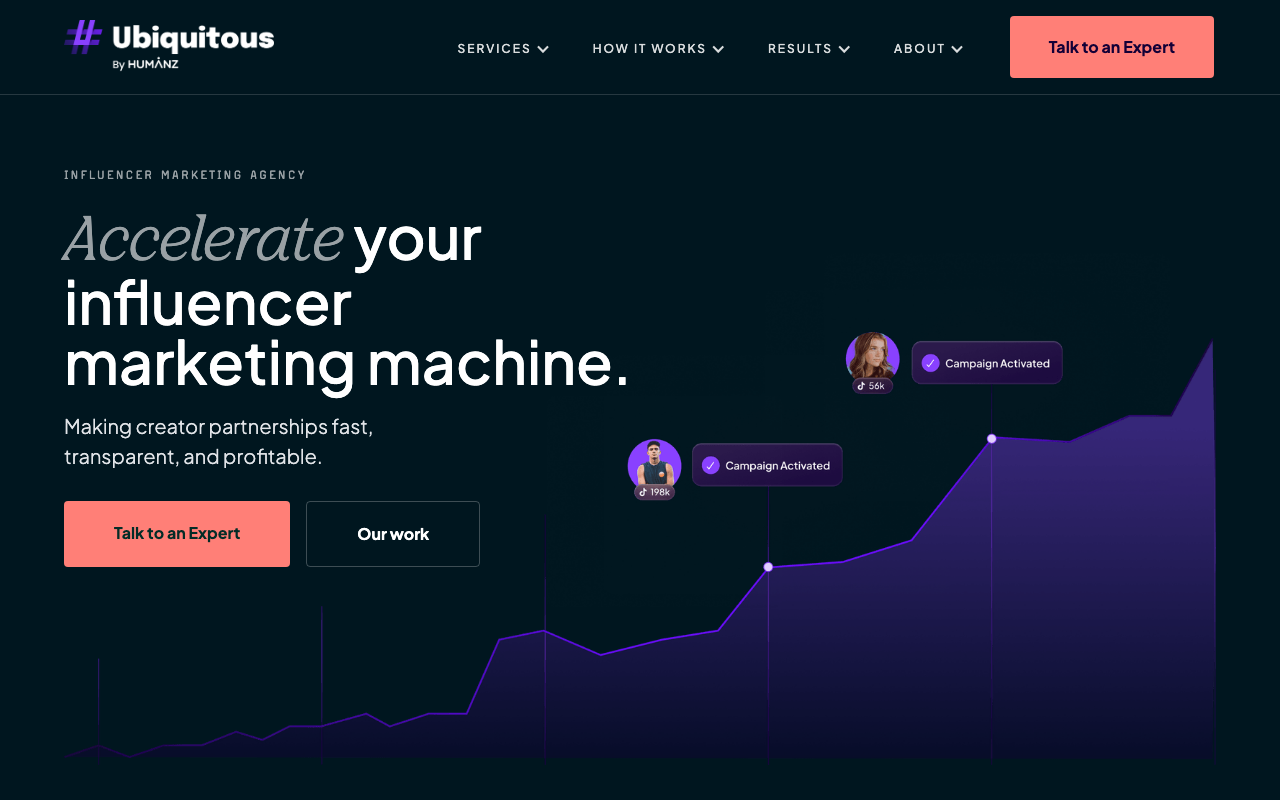
Full disclosure: this is us, and we built the agency specifically to pass the four tests above. Ubiquitous has activated 40,000+ creators for brands including Amazon, Lyft, GNC, Disney, and Bloom Nutrition, with all creator operations in-house: selection, recruiting, negotiation, payment, briefing, content QA, and posting to spec. Clients approve strategy and creative direction. They do not chase creators.
The numbers are public. A $4.31 CPM for Lyft with 8.1 million views. 45.9 million views at a $6.24 CPM for Eternal Water. 40 million views at a sub-$3 CPM for FilterBuy, a company that sells air filters. Jinx's multi-year program that helped carry the pet-food brand toward $100M in revenue.
On the two tests most agencies fail: paid amplification is a managed service here, including whitelisting, Spark Ads, and dark posts on TikTok, Instagram, and YouTube, and tracking runs through our parent platform Humanz, which connects creator content to revenue attribution rather than stopping at impressions.
Best fit: consumer brands doing $20M+ in revenue that want to build influencer into an ongoing acquisition channel, typically starting with a $100K, three-month proof of concept. Wrong fit: one-off launch stunts and brands shopping for a single viral moment.
2. Viral Nation — Best for global, enterprise-scale campaigns
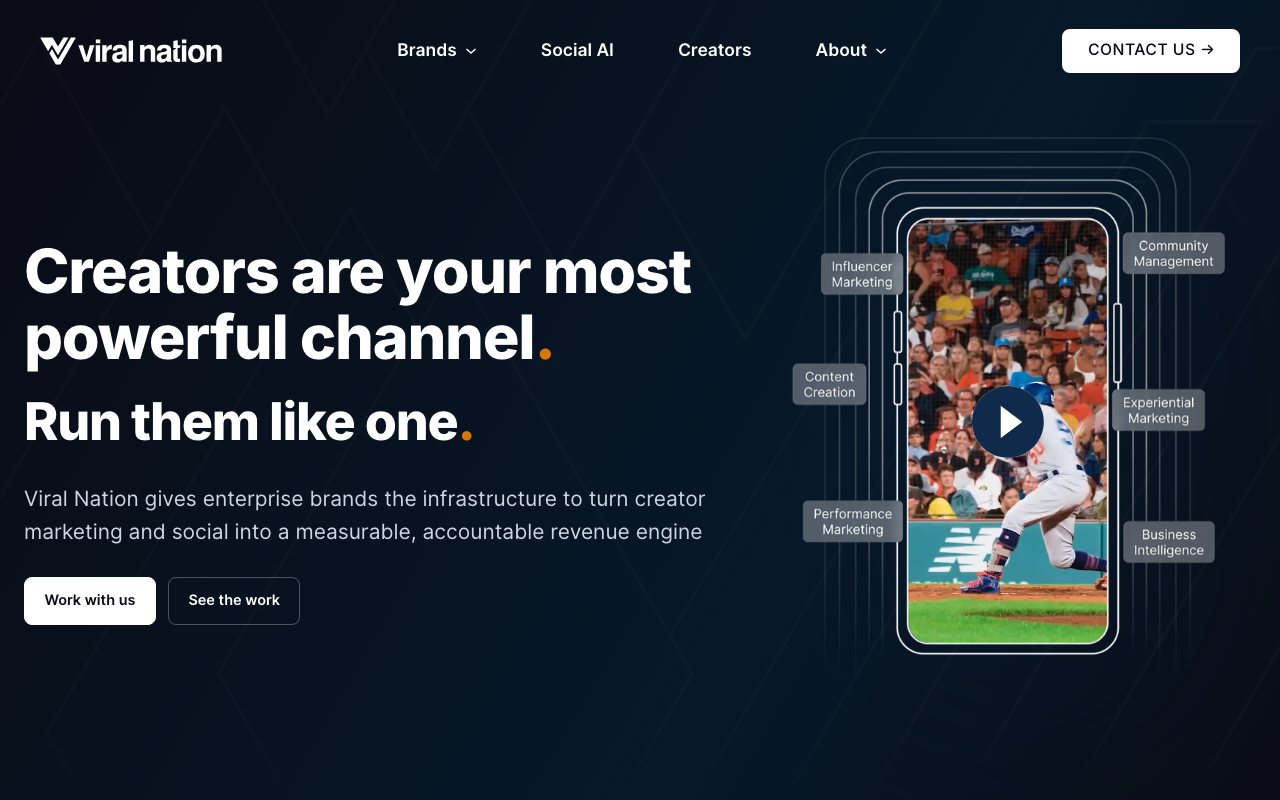
Founded in 2014 in Toronto, Viral Nation is among the largest influencer agencies in the world. The agency reports 85 billion+ views driven by its creators in 2025 for clients including Amazon, Uber, Walmart, Samsung, and e.l.f. (Viral Nation).
The full-service claim holds: influencer marketing, paid media, content studio, and community management sit under one roof, and their business-intelligence tooling processes over a million posts a day. Brand-safety and compliance infrastructure is a real differentiator for regulated industries, where one bad post is a legal event rather than an awkward one.
Best fit: global enterprises running campaigns across many markets at once. Mid-market brands can get small-account treatment inside a machine this size.
3. The Goat Agency — Best for multi-market international reach
Goat was founded in 2015 and now fields 750 social and influencer marketing specialists across 41 markets and six continents, working with L'Oréal, Unilever, Mars, and Calvin Klein (The Goat Agency). Their proprietary IBEX technology adds forecasting and decision intelligence before a campaign launches, which takes some of the guesswork out of casting.
The operating model is genuinely end-to-end, including media, and the multi-market muscle is the point: one program, many countries, consistent execution.
Best fit: brands that need the same program to work in Berlin, São Paulo, and Singapore. A single-market DTC brand is paying for reach it will not use.
4. NeoReach — Best for data transparency and self-serve control
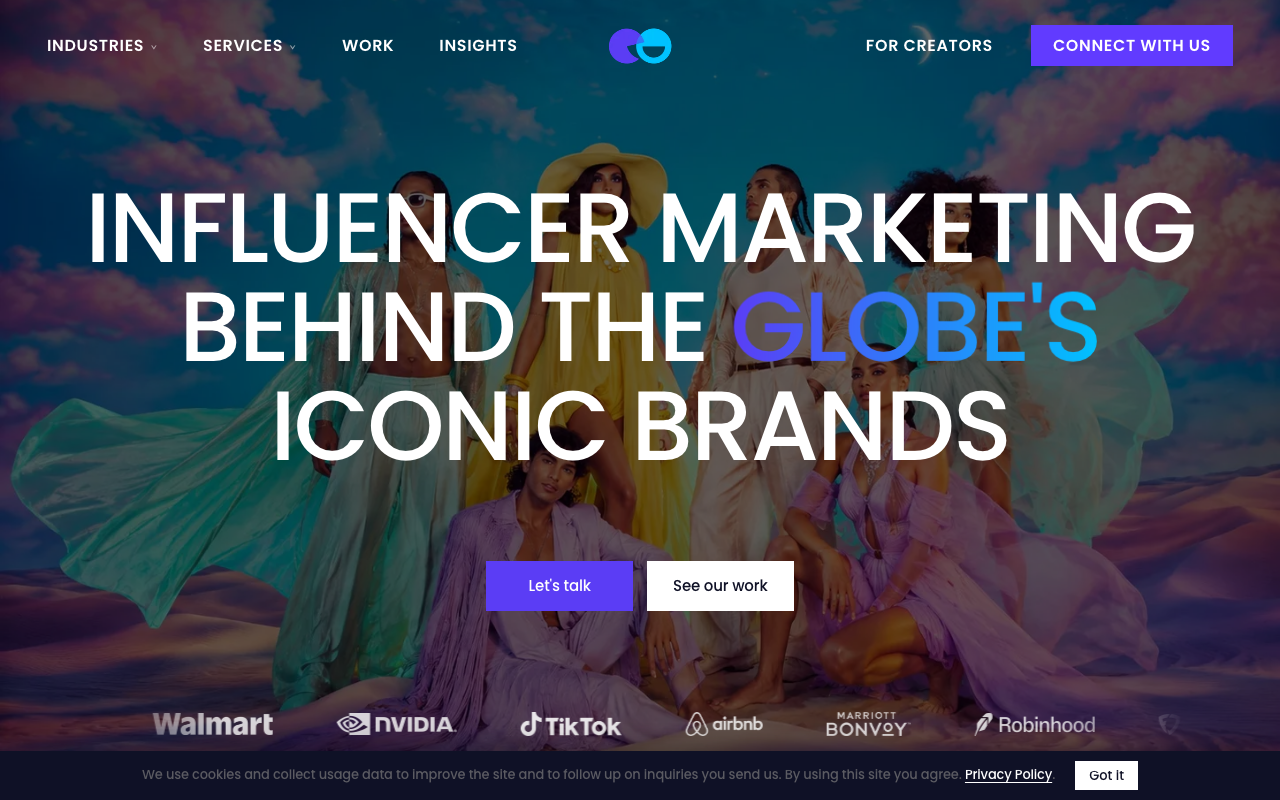
NeoReach has engineered campaigns for NVIDIA, Netflix, Walmart, FanDuel, Airbnb, and Robinhood since 2013, with $350M+ in influencer spend managed and a 90 percent client renewal rate (NeoReach). The agency describes its managed offering as "full-service influencer marketing, brief to wrap," alongside paid social, UGC production, and product seeding.
One honest caveat for this list: NeoReach also sells a self-serve platform, which means "full-service" is a tier you select, not the default. Buy the managed tier if you want the end-to-end promise, and confirm in writing who runs creator coordination day to day.
Best fit: data-hungry teams that want agency execution without giving up visibility into the pipes.
5. Obviously — Best for high-volume enterprise execution
Obviously has run 152,000+ creator collaborations producing 425,000+ unique pieces of content and 5 billion+ organic impressions, with partners including Google, Amazon, Converse, and Ulta (Obviously). Everything is managed in-house: strategy, matching, negotiation, product seeding logistics, custom dashboards, and reporting, plus UGC repurposing into commerce channels.
Throughput is the specialty. When a program needs 400 creators shipped, briefed, and posting on schedule, this is one of the few shops built for that volume without the wheels coming off.
Best fit: enterprises that need scale and reliability more than bespoke creative concepts. Highly custom, concept-driven campaigns are not the core motion.
6. Linqia — Best for performance-driven CPG at scale
Linqia, founded in 2012 in San Francisco, calls itself the leading independent influencer marketing agency in the US and works with brands like Albertsons, Danone, and Bayer (Linqia). The model was built for a specific buyer: large CPG organizations that need influencer results proven to a committee, with paid amplification run from creator handles and measurement integrated with 15+ third-party partners.
That measurement culture shows up in the deliverables, and their content pipelines into paid and retail media are strong.
Best fit: CPG and food brands with committee-grade reporting requirements. Niche DTC brands may find the model shaped for a different buyer.
7. The Influencer Marketing Factory — Best for short-form-native campaigns
The Influencer Marketing Factory is a performance-led shop focused on TikTok, Instagram, and YouTube short-form video. If you are shopping specifically for a TikTok influencer marketing agency, this is one of the first names you will hear, and the reputation is earned: the team understands why a format works natively and refuses to force content that fights the platform.
Service is end-to-end, from creator sourcing through paid amplification and reporting, typically for consumer and tech brands launching products to younger audiences.
Best fit: brands whose entire audience lives in short-form. Enterprises needing massive always-on infrastructure will find the larger shops on this list better equipped.
8. inBeat — Best for micro-influencer UGC and paid-social creative
Montreal-based inBeat runs high-volume micro-creator programs for brands like New Balance, Bumble, 7-Eleven, and Nestlé, with $20M+ in paid media managed and case studies citing a 65 percent reduction in CPA and 300+ assets shipped per month for a single client (inBeat). The model is deliberately built as a creative engine for paid media: creator content produced, cleared, and fed straight into ad accounts.
That makes inBeat unusually strong on the amplification test, since paid is the product rather than an add-on.
Best fit: DTC brands that burn through ad creative and need a steady UGC supply. Wrong fit if you want celebrity-tier reach or big organic moments.
9. Open Influence — Best for brand-safety-sensitive enterprise programs
Open Influence has been at this since 2013, reports 50 billion+ in total reach across campaigns in 70+ countries, and says 38 percent of its clients are Fortune 500 brands, with a 92 percent renewal rate (Open Influence). The service is explicitly full-service: strategy, campaign management, paid media amplification, and in-house content production, run with a caution-first style of heavy vetting and content review.
The compliance rigor is the draw. It suits categories where reputational risk is priced in dollars.
Best fit: finance, pharma, and household names that need every post reviewed twice. Startups that value speed over process will feel the drag.
10. HireInfluence — Best for high-touch experiential activations
HireInfluence has served brands like McDonald's, Microsoft, Adidas, Target, and Warner Bros. since 2011, from teams in Austin, Los Angeles, and New York (HireInfluence). The agency runs fully managed campaigns spanning talent sourcing, experiential ideation and fulfillment, content amplification, and paid media management, with a signature in experiential activations most influencer shops cannot produce.
Best fit: brands that want a memorable, bespoke campaign moment with creators woven in. Less suited to always-on acquisition programs where volume and iteration matter more than concept.
How to Vet a "Full-Service" Claim Before You Sign
Four questions expose the gap between the pitch deck and the operating model. Ask them on the first call, whatever tier of influencer marketing specialists you are evaluating.
Who runs the ad account when we amplify creator content, you or us? A true full-service agency manages whitelisting permissions, dark posts, and spend, or plugs into your ad account with your approval flow. If the answer involves "recommendations for your media team," you have found the boundary of the service.
Show me a tracking report from a live program. Not the case study PDF. The actual weekly or monthly artifact a client receives, with post-level data. You will learn more from that one document than from the whole deck.
Who is the creators' day-to-day contact once we sign? The only acceptable answer is a named person at the agency. If your team appears anywhere in the posting-week workflow, the coordination labor is coming back to you, one Slack thread at a time.
What happens when a creator posts off-brief or misses an FTC disclosure? Good agencies have a boring, procedural answer: catch it in QA, request the fix, escalate per the contract. The disclosure part is not cosmetic, since brands carry real liability for non-compliant posts.
Then apply the pricing reality check. Real end-to-end management costs 15 to 30 percent of creator spend, or a monthly retainer that typically runs $3,000 to $30,000, and a $100K creator plan usually lands at $115K to $130K all-in (InfluencerFee, 2026). A "full-service" quote dramatically below that range is not a bargain. It is a list of things that are not included, formatted as a price. If you are earlier in the journey, our guide to starting influencer marketing covers how to size the first program.
Frequently Asked Questions
What does a full-service influencer marketing agency do?
A full-service influencer marketing agency manages the entire program: strategy, creator selection and vetting, recruiting, rate negotiation, contracting, payment, briefing, content QA, posting to spec, paid amplification of the content, and detailed performance tracking. The brand approves strategy and creative direction. The agency does everything else.
How is a full-service agency different from an influencer platform?
A platform is software: a creator database, filters, and dashboards, with all the operational work still done by your team. A full-service agency owns the outcome and supplies the people who produce it. Hybrids like NeoReach offer both, so confirm which tier of influencer marketing services you are actually buying.
The cost comparison hides the real difference. Platforms run a few hundred to a few thousand dollars a month in software fees against an agency's 15 to 30 percent of spend, which looks like a bargain until you price the headcount: someone on your payroll still runs discovery, outreach, negotiation, briefing, QA, and reporting. Platforms fit brands with an existing influencer ops team that needs better tooling. Agencies fit brands that want the outcome without building the department. Smaller brands testing the channel often start on a platform; past the proof-of-concept stage, the agency math usually wins once your team's time is priced in.
How much does a full-service influencer marketing agency cost?
Typical structures are 15 to 30 percent of managed creator spend, monthly retainers from roughly $1,000 at the low end to $100,000+ for enterprise programs, or project fees (InfluencerFee, 2026). Expect a $100K creator budget to land around $115K to $130K all-in with management included.
Do full-service agencies handle the paid ads too?
Yes, by definition. Paid amplification is where creator content produces its largest returns: creator-led ads deliver up to 4x higher CTR and 50 percent lower CPC than standard brand ads (Aspire data via Billo, 2025), and whitelisted content consistently beats brand-page creative on CPA. An agency that cannot run the paid side is, by this article's standard, not full service.
Should I talk to the creators directly?
With a true full-service agency, no. Creator coordination, follow-ups, and fix requests are the service. Your team sets strategy, approves creative direction, and reads the reporting. If you find yourself messaging creators about late posts, you bought talent matchmaking, whatever the proposal called it.
How do you choose the right full-service influencer marketing agency?
Run the four tests first: paid amplification in-house, creator search beyond any roster, a real tracking artifact, and zero brand-to-creator coordination. Then match the agency's center of gravity to your goal, whether that is global scale, CPG measurement, UGC volume for paid, or experiential concepts. Before signing, ask for a live program report, named references in your category, and a proposal structured as a three-month proof of concept with success metrics defined up front. A named account lead and a weekly reporting cadence are the norm among good agencies; vagueness on either is a signal.
Final Thoughts
The four tests do the shortlisting for you. Ask who runs the paid amplification, whether the creator search extends past the agency's own roster, what the tracking artifact actually looks like, and who talks to the creators. Most "full-service" claims fall over on the first question, and nearly all of them fall over by the fourth.
The best influencer marketing agency for your brand is the one that passes all four tests and fits your motion, and the ten above each pass with a different center of gravity: global scale, CPG measurement, UGC volume, experiential concepts. Pick for fit, size the first engagement as a three-month proof of concept, and evaluate like you are choosing a partner to build a channel with for years, because you are.
Talk to Ubiquitous when you are ready to build.